

Alternatives
Alternative
investments,
without the overhead
Everything you need to offer private markets—discovery, subscriptions, custody—in one place.
Alternative investments are speculative, may be illiquid or have limited liquidity, and may result in loss of some or all principal. Not suitable for all investors and subject to eligibility requirements. Review the applicable offering documents before investing.

1
Platform. End-to-end.
No integrations.

20+
Flagship partner funds
planned—and growing.

$0
Custody fees on
partner funds.
Altruist Financial LLC (“Altruist Financial”) does not charge a separate custody fee for alternative investments. However, certain funds charge shareholder servicing fees that are retained in whole or in part to offset custody-related costs. Please refer to each fund’s offering documents for a complete description of applicable fees. Altruist Financial charges other fees in connection with its services. Please see the Altruist Financial LLC Fee Schedule for a complete description of fees that may apply to your account.
Alternatives.
Done in a few clicks.
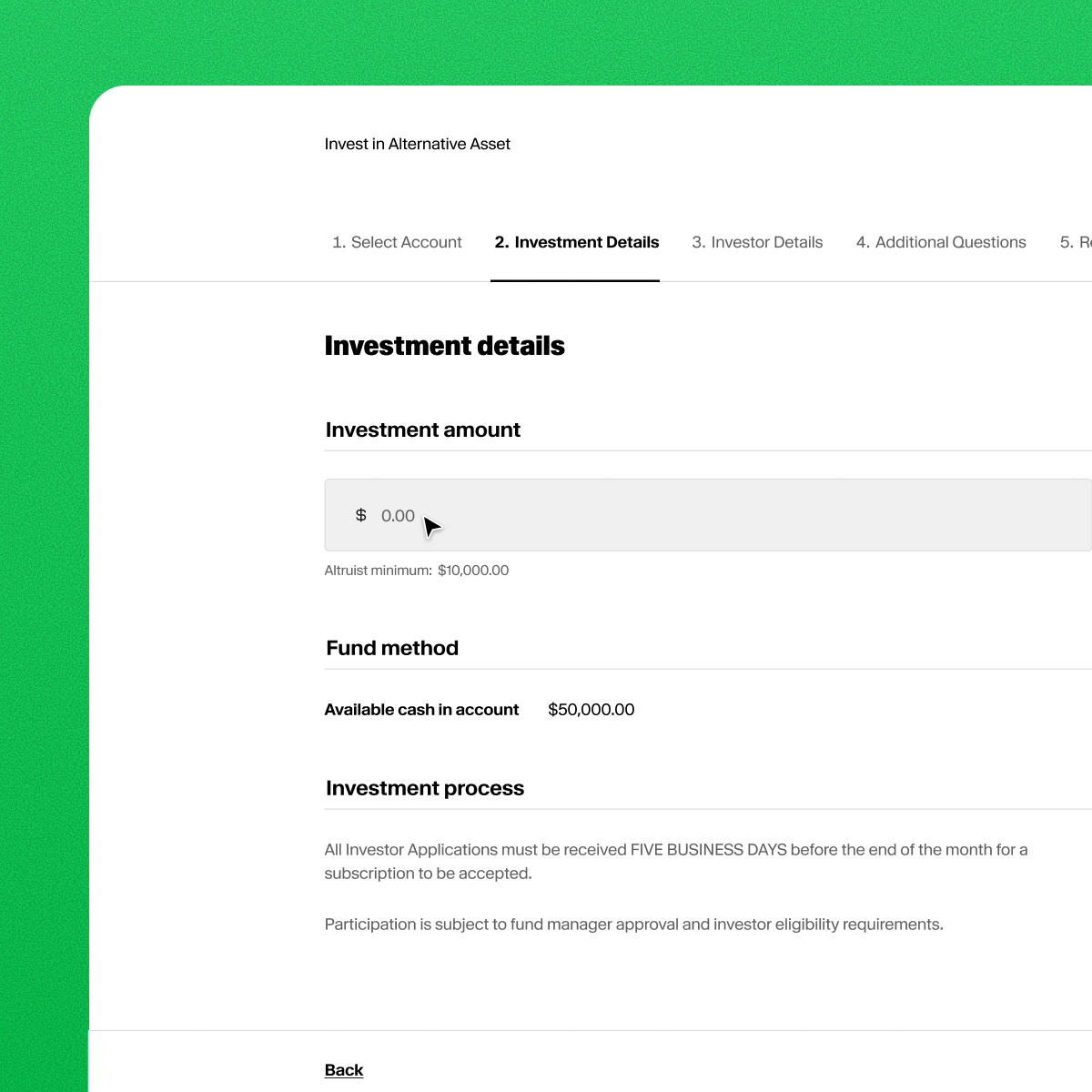
Fill out subscription documents in minutes for one client—or many—on Altruist.
For illustrative purposes only. Fund materials and platform screens shown are examples and do not represent actual transactions or offerings.
Fully digital
Complete the entire alternatives experience inside Altruist with document prep, e-signatures, and everything in between.
One complete portfolio view
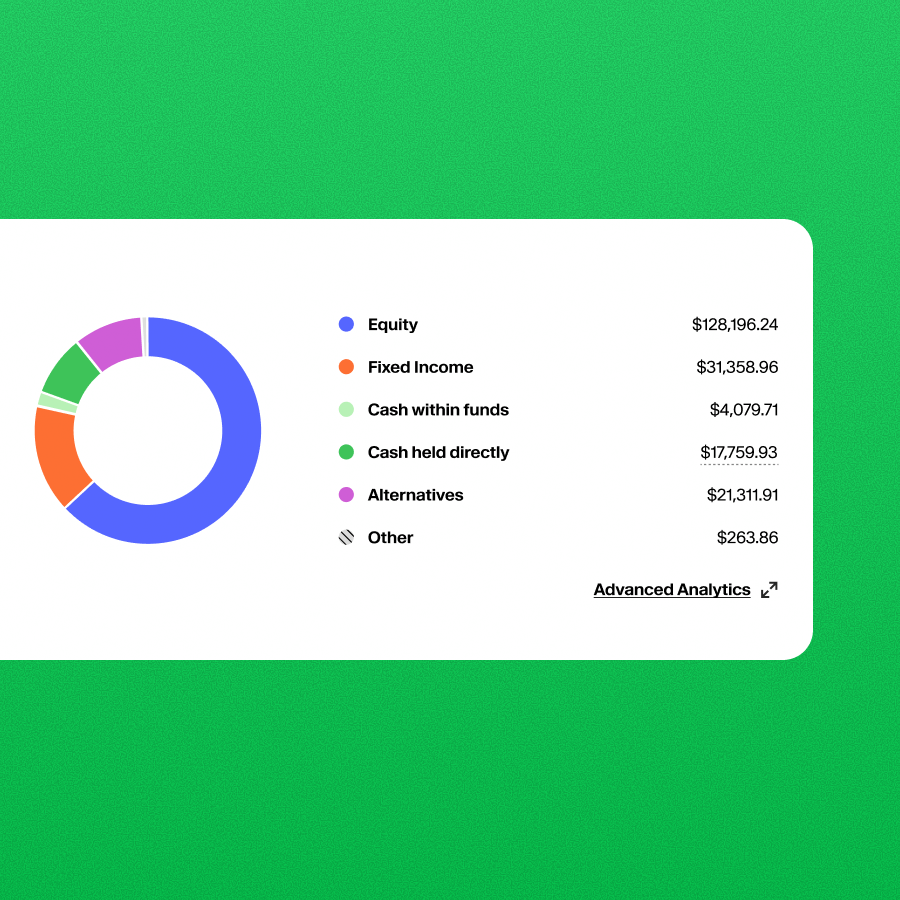
View holdings, statements, billing, and reporting across alternatives and traditional assets all in one place.
Easy redemption process
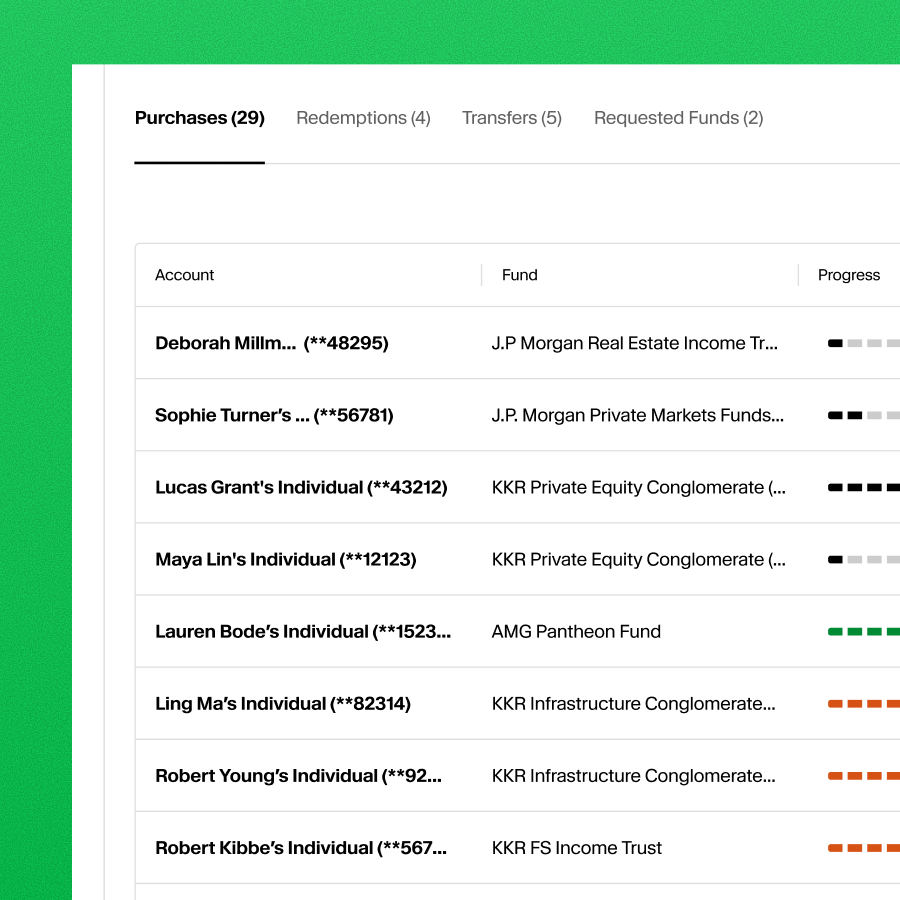
Redeem alternative investments with the same digital workflow as subscriptions.
Seamless transfers
Move existing evergreen alts positions into Altruist custody without manually filling out transfer docs.
The capabilities described above are limited to funds offered through the Altruist Alts Marketplace. Subscription, redemption, and transfer terms vary by fund and are set forth in each fund’s offering documents, including any gates, prorationing, or partial fill provisions.
For the advisors who want to bring more strategies to more clients
Altruist did not pay for this testimonial but earns revenue from advisors who use our platform. This testimonial may not represent others’ experiences and isn’t a guarantee of results. Alternative investments involve material risks, including potential loss of principal, and are not suitable for all investors.
How it works
From fund discovery to billing, the entire alternatives experience lives inside Altruist.
Invest
Browse the fund marketplace and fill out subscription documents in a few clicks.
Report
See alternative holdings alongside your traditional assets in one unified view. NAV updates as soon as it’s received from the fund administrator.
Manage
Redeem, transfer, and bill on alternative investments through the same engine as the rest of your book. Same statement, same invoice, no manual reconciliation.
Capabilities shown apply to funds in the Altruist Alts Marketplace and are subject to fund manager approval, investor eligibility, and the terms of each fund’s offering documents, including redemption terms. NAVs update when received from fund administrators and may not reflect current market value. Illustrative only; not actual client data.
Alternative asset managers on Altruist
We built our lineup around the managers advisors asked for most, and we keep adding more.




Reference to specific asset managers does not constitute an endorsement or recommendation. Fund availability varies and is subject to change. Logos and trademarks are the property of their respective owners.
Alternative investment strategies on Altruist
Learn how each asset class works and the role it can play in a well-rounded portfolio.

Infrastructure
Infrastructure funds invest in real assets, like energy systems, transportation networks, and utilities. They may provide stable, long-term returns and act as a buffer against inflation.

Private equity
Private equity invests in companies that aren’t listed on the stock market. Funds pool capital from investors to buy and grow private companies—from early-stage ventures to established companies—with potential returns coming when those businesses are eventually sold.

Real estate
Real estate alternatives invest in property without directly owning buildings—through funds that hold commercial, residential, or mixed-use assets. They can provide steady income and diversification from public markets.

Private credit
Private credit involves lending money directly to businesses, outside of traditional banks. Investors aim to generate returns through interest payments on those loans.

Multi-strategy
Multi-strategy funds invest in several alternative asset classes—private equity, private credit, real estate, and more—giving clients access to a range of investment opportunities within a single fund. They offer built-in diversification.

Coming soon: Pre-IPO
Pre-IPO funds invest in private companies before they list on the public stock exchange. Returns depend on whether companies eventually go public or are acquired at a higher valuation, which may not occur.
Alternatives, the easy way
No extra systems, no manual paperwork, no juggling platforms. Just more time with your clients.
Frequently
asked
questions
What are alternative investments?
Alternative investments are assets that fall outside traditional categories and include private equity, private credit, collectibles, real estate, infrastructure, and more.
Advisors use them for portfolio diversification and to access opportunities that listed stocks and bonds alone can’t provide.
What is an example of an alternative investment?
Private equity is one of the most common examples of an alternative investment. That means investing in companies that aren’t publicly traded.
Private credit, where investors lend directly to businesses outside the traditional banking system, is another.
Real assets, such as real estate and infrastructure, round out the most widely used categories. On Altruist, you can access funds from managers like Blackstone, Apollo, KKR, JPMorgan, and Pantheon across these categories.
What are the most popular alternative investments?
Private equity and private credit have seen the most growth in advisor adoption over the past several years.
Real estate and infrastructure are also widely used. On Altruist, we’ve built our initial fund lineup around the managers and strategies advisors ask for most.
How do alternative investments differ from traditional investments?
Traditional investments—stocks, bonds, mutual funds, derivatives—are financial assets that trade on public markets and are priced daily.
Alternatives are typically less liquid than stocks or bonds, meaning capital is committed for a longer period of time, and they can move independently of public markets. That’s part of what can make them a useful complement to a traditional portfolio.
How are alternative investments valued?
Unlike publicly traded stocks, alternative investments typically don’t have a daily market price. Valuation typically happens periodically—monthly or quarterly. This is one reason NAV updates in Altruist are posted as soon as they’re received from the fund administrator.
What are the risks associated with alternative investments?
Among other risks, alternatives are typically illiquid, meaning capital is locked up for a period of time. And unlike stocks, they aren’t priced daily, which can make them harder to value. Fees may also be higher than traditional investments, and the loss of some or all principal can occur.
Advisors should review offering materials for an alternative investment to understand its particular risks.
Which account types support alternative investments?
Individual and joint accounts are supported today. Retirement accounts are next, with trust and entity accounts following. If a specific account type is critical to your business, let us know.
What are the investment minimums, and do clients need to be accredited?
Minimums vary by fund and share class. Accreditation requirements are set by the fund, not Altruist, and are disclosed on each fund’s detail page. The platform validates eligibility as part of the subscription flow.
What does the subscription process look like for the client?
The advisor initiates the subscription in Altruist and completes fund-specific paperwork digitally. The client receives subscription documents for review and e-signature—no printing, scanning, or mailing. The fund’s offering documents are available throughout the process for both advisor and client.
Alternatives are a nightmare of forms. What makes Altruist different?
A single alts investment can mean analog subscriptions, paper forms, and additional custodial paperwork.
At Altruist, our model means one streamlined digital flow—no extra paperwork, no back-and-forth—so you can bring alts to more of your eligible clients.
Some providers have hundreds of funds—you only have a handful at launch. Why is that?
We started with impact, not volume. Most advisors work with a handful of funds regularly, so we focused on the funds advisors told us they wanted most. The marketplace is already growing, and advisor demand drives what gets added next.
If there is a fund that you’d like to see on our platform, please submit it here.
How do you prioritize which funds get added to the marketplace?
Advisor demand drives what comes next. If you’re evaluating Altruist and a specific fund is important to your business, tell us—it factors directly into what we prioritize.
The fund I need isn’t in the marketplace—does that block us?
Not at all. Custody non-marketplace funds by filling out the subscription documents through your preferred platform and submitting them to Altruist. We handle custody, reporting, and billing from there.
Can alts investments be included in a model or bought through the rebalancer?
Not yet—but it’s on the roadmap. The vision is a rebalancer that manages public and private assets together, including triggering alts subscriptions automatically. We’re working toward this and expect to have more to share by the end of 2026 or early 2027.
How do redemptions work?
It depends on the fund structure. Evergreen funds typically have quarterly tender windows with advance notice requirements.
You submit a redemption request through Altruist, and we handle processing and settlement. Each fund’s detail page outlines its specific liquidity terms, including notice periods and any gate provisions.
Can I transfer existing alternative positions to Altruist?
Yes. You’ll be able to move many alts positions held away into Altruist, so everything lives on one platform for reporting, billing, and client visibility.
How does alts data flow to third-party reporting tools (Orion, Black Diamond, Addepar)?
Alternative holdings are included in the data sent to integrated platforms—symbol, name, NAV, and market value. How that data renders depends on each platform’s own integration.
If you use a separate tool specifically for alts reporting, we’d recommend checking with that provider directly on how the data renders on their end.
How are alternative investments reported for taxes?
Some alternative funds issue K-1s rather than 1099s, and delivery timelines vary by fund—often later than traditional tax documents. Tax documents are provided by the fund administrator. Each fund’s detail page notes the expected tax document type.
What’s the custody fee for funds not in the marketplace?
For funds outside the marketplace, custody is $200 per position and capped at $400 per account. Other custodians typically charge $200-$300 per position on non-program alts. Our solution is designed to make sure a missing fund is never a reason to keep assets elsewhere.
Are there additional fees for investing through the marketplace?
There is no additional Altruist platform fee for marketplace funds. You pay the fund’s own management and performance fees, disclosed on each fund’s detail page. Altruist may receive compensation from these funds.
Altruist Financial charges other fees in connection with its services. Please see the Altruist Financial LLC Fee Schedule for a complete description of fees that may apply to your account.
Tell us about your firm and we’ll map out how to get your practice running and scaling on Altruist.
Altruist does not charge a separate custody fee for alternative investments. However, certain funds charge shareholder servicing fees that are retained in whole or in part to offset custody-related costs. Please refer to each fund’s offering documents for a complete description of applicable fees.
Alternative investments are speculative, involve substantial risk, and are not suitable for all investors. They are generally illiquid or have limited liquidity, with extended lock-ups and redemption restrictions subject to each fund’s governing documents. Valuations are provided periodically by the fund sponsor or administrator and may not reflect current market value. Fees are often higher than traditional investments and include management fees, performance fees, and other fund expenses that reduce returns. Many alternative investments are not eligible for SIPC protection and are not FDIC-insured. Investing in alternatives may result in loss of all capital invested. Some alternative investments are limited to accredited investors, qualified clients, or qualified purchasers as defined under federal securities laws. Eligibility is determined per investment. Any offering is made only pursuant to the applicable fund’s offering documents.
Altruist Financial LLC (“Altruist Financial”) receives compensation from certain marketplace funds, typically through shareholder servicing fees paid out of fund assets. This creates a financial incentive for Altruist Financial to include and feature those funds. Inclusion in the marketplace is not a recommendation, endorsement, or assurance of suitability. References to specific asset managers, fund sponsors, or third-party platforms are not endorsements. Logos and trademarks belong to their respective owners.
This page references products and features in development or planned for future release. These may not launch as described, on the timelines indicated, or at all.
Account values, client names, fund holdings, and platform screenshots shown are illustrative only and do not represent actual clients, portfolios, or performance.